Comment of the Week

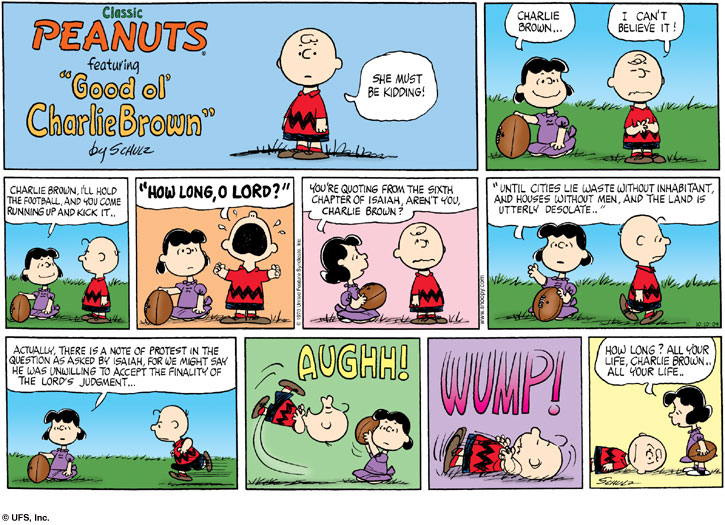
Tune in tomorrow as Rev. Croom embarks on a new life of selective observance. He'll dine and dash (thou shalt not steal), covet Herb's wife, murder Jamaal, and make a graven image, but he'll at least call his mom to wish her a happy birthday (honor thy father and mother). The funnies haven't been this theologically bold since Judge Parker financed the construction of a giant needle big enough for a dozen camels to thread.

Abram Beazer

Post Content

Prince Valiant, 8/8/04

Click here to view the full-sized comic in a new window.

I made a cheap shot last week when I cited Prince Valiant in an entry about the comics and “failed” classicists (though as a failed classicist myself, it was largely meant to be self-deprecating). As a well-informed but anonymous reader pointed out, the storylines for Prince Valiant are written by John Cullen Murphy, a medieval history major in college and current managing editor for the Atlantic, the hem of which publication’s robes I am not worthy to touch. Prince Valiant is in fact one of my great, non-ironic pleasures in the comics. Back when I was in grad school, in the waning days of the Clinton administration, my specialty was in what was then trendily called “the Late Antique” (no doubt it has a different name now), which covers very broadly the period from about the third century A.D. to about the seventh. It’s later than the Ancient Rome of I, Claudius, and it’s earlier than the knights-in-armor-and-damsels-in-distress middle ages; and so, while burdened with the dire poverty, grinding workload, and blighted social life that afflict all graduate students, I also had the additional problem of describing to normal human beings what the hell it was I actually studied.

Now I wish that I had been familiar with Prince Valiant then, because if I had, I just could have said, airily, “Oh, you know, it’s the stuff that happens in Prince Valiant.” In a country where anything that happened before World War II is generally considered ancient history, in the comics pages every Sunday we have a strip dedicated to goings-on sometime in the middle of the 500s A.D. While of course the characters’ adventures happen more or less outside the realm of real history, in my several years of following it I’ve yet to spot any real historical goofs.

One thing I’ve noted over time is the absence of any references to the magic and wizardry that most people associate with the time of King Arthur. In addition, although the characters live in a world that is obviously Christian (Galan is seeking the Holy Grail, after all, and has met with the Pope on his quest), that aspect is significantly underplayed. The current action features a hermit on the spot where Moses supposedly received the Ten Commandments reading from an unnamed “sacred book.” He tells the story of the Assyrian seige of Jerusalem from 2 Kings 18-19 — except that where the Old Testament has the Assyrian army struck down by an angel of God, our hermit attributes the victory to the King of Judah’s ingenuity in blocking up a spring. One imagines that the people who are up in arms about creeping secular humanism in the funnies are shooting off angry letters to the editor about this comic (written by a major player in the East Coast liberal media elite, no less!). Personally, I’m just glad to have a counterweight to Johnny Hart.

Of course, Prince Valiant is beautifully drawn, too. It’s impossible to find current strips online, though, which is why I haven’t commented on it earlier. I ended up scanning this one from the paper myself, cutting it up and reassembling in with image editing software, which was a big pain in the ass. So I insist rather forcefully that you click on the link to the full-sized comic above and appreciate the artwork, particularly in the dark and moody middle panel.

Post Content

Mary Worth, 8/7/04

Hey, kids! Remember nearly four weeks ago, when Wilbur was about to ask out lovely widow Iris? Been wondering what’s happened in the month since then? While no doubt entire relationships have come and gone since then in the real world, in Mary Worth, we’ve had exactly one extremely long and tedious first date (if you can call it a date when you bring your college-age daughter along). At this rate, Wilbur and Irma might actually get busy sometime in 2009.

Anyway, just thought I’d keep you posted, in the spirit of the title of this blog. Also, I’d like to point out the loving detail that the artist has put into the hair that coats the back of Wilbur’s hand and peeks out at the top of his chest — as well as the three lonely strands that are lovingly combed across the top of his head. I think you’re counting your chickens before they’re hatched, there, Wilbur.

Post Content

Marmaduke, 8/6/04

When I was in graduate school, my roommate and I decided to celebrate some minor life victory (and when you’re in graduate school, every victory is minor) by going to see a movie; for some reason, the movie we decided to see was Batman and Robin. We went in with high spirits, but by around forty-five minutes into it, I was trying to see what I could cram into my ear canals to somehow keep from having to listen to the dialog. At one point, Arnold Schwarzenegger, playing Dr. Freeze, says, “Do hear dat sound? It is da harbinger of your doom!” This man is now governor of one of your more major states.

Three or four years later, a date and I went to see American Virgin, which, for those who haven’t seen it (and you are legion), was a movie that was originally titled Live Virgin and spent several years “in the can,” as they say, due to its extreme awfulness. It did, however, star Mena Suvari, who would go on to appear in a pair of fairly well-received films called American Beauty and American Pie, so presumably the owners of Live Virgin said, “Let’s add ‘American’ to the name and release it on the unsuspecting masses!” And so it was done. I won’t go into this film’s awfulness in detail, except to say that, at its climax, respected British character actor Bob Hoskins has a depiction of a penis forcibly tattooed onto his forehead.

These are probably the two worst movie-going experiences I’ve ever had. While I was sitting in the movie theater on these two occasions, I fidgeted. I rolled my eyes. I sighed loudly. I made snide comments to my moviegoing companions, to the strangers in the rows ahead of me, and to the cruel universe at large.

I did not, however, cry. Nobody — not ever lovably destructive Great Danes — weeps because a movie is bad. Sometimes, they cry because a movie is extremely moving. So either (a) Marmaduke is a big sap who cries at cheesy movies, (b) Marmaduke’s owner is a heartless soul who doesn’t share her dog’s deep wellsprings of empathy, or (c) this comic strip has no insight on actual people’s reactions to actual films. I vote for (c). I suppose it’s harder to draw an irritated dog than a crying one, but that’s a flimsy excuse.

(Incidentally, the other thing I didn’t do during these movies was walk out in disgust. This might give you some insight into the pathology that drives me to read Marmaduke every day.)

About this Post

Comments are closed.